Lumped Isothermal Method - Detailed Discussion
When this Arrow Steady Solution Method is used, the following simplifying assumptions apply:
-
Constant Temperature - All pipes will use a constant static temperature defined in the Solution Method panel of Analysis Setup or overwritten by temperatures specified for individual pipes. Any entered heat transfer data for pipes is kept in the background in case the user switches back to one of the marching methods.
-
No Elevation Changes - All elevation data is neglected. The output will still show the elevation as entered by the user, and the data is kept in the background in case the user switches back to one of the marching methods. Since elevation effects are usually not very important in gas systems, neglecting elevation changes is frequently an acceptable approximation. One application where this is definitely not the case is in Rotating Systems.
-
Calorically Perfect Gas - This solution method assumes a calorically perfect gas law, meaning that the specific heat capacity is constant, and therefore the specific heat ratio (gamma) is also constant. However, note that this only applies to the mathematical derivation of the equation below. In the final solution output, the specific heat may still change due to other settings in the model such as which fluid library is used, what equation of state model is selected, or what enthalpy model is selected. For example, using the REFPROP fluid library may result in values of Cp that change down a pipe.
In isothermal flow, the gas static temperature remains constant. The tendency is for gas to cool as it flows along a pipe. For the temperature to remain constant, an inflow of heat is required.
When the temperature remains constant, it removes one of the unknowns from the Fundamental Equations. For example, the equation of state for an ideal gas has the density become directly proportional to pressure, and an analytical solution can be obtained if elevation changes are neglected (e.g., see Saad, 1993, pp. 264-269):
|
|
(44) |

where the T subscript on L emphasizes isothermal. Integrating from point 0 to L,
|
|
(45) |
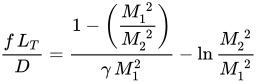
Isothermal flow behavior results in a different relationship for sonic choking as compared to adiabatic flow. In fact, to truly maintain isothermal flow up to the sonic point requires an infinite amount of heat transfer. This results in the strange but mathematically correct conclusion that sonic choking occurs at a Mach number less than 1 for isothermal flow. Sonic choking will occur at 1/sqrt(gamma) for isothermal flow, where gamma is the isentropic expansion coefficient (Saad, 1993, pp. 267). Practically speaking, isothermal flow will not remain isothermal at high velocities.
Similar to the Lumped Adiabatic method, Equation 45 is solved for each pipe, using an average value of friction factor and g for each pipe. The solution of Equation 45 typically is iterative where the unknown is M2.